
Insights Blog
From Scarcity to Advantage
Why Circularity Belongs on the Automotive Board Agenda
Author: Peter Maithel — Senior Client Partner & Strategic Industry Advisor, PCG
Executive Summary —
- Material scarcity has moved from a procurement issue to a strategic constraint on how automakers design, build and service vehicles.
- Chokepoints now exist at every stage of the value chain, from mining and primary production to component manufacturing, assembly, service and end-of-life, and are increasingly driven by geopolitics and trade policy.
- Leading OEMs are responding with circular strategies (designing for disassembly, closing scrap loops, substituting constrained materials and forming circular supply partnerships) that reduce their dependence on primary materials.
- AI-driven digital platforms operationalize these strategies at scale by enabling digital traceability, supply chain visibility, and operational resilience.
- Companies that build these capabilities now can turn tightening regulation, such as the EU End-of-Life Vehicles Regulation (ELVR), into an advantage in cost, supply security, and margin.
Material Scarcity is now an Industry-wide Constraint —
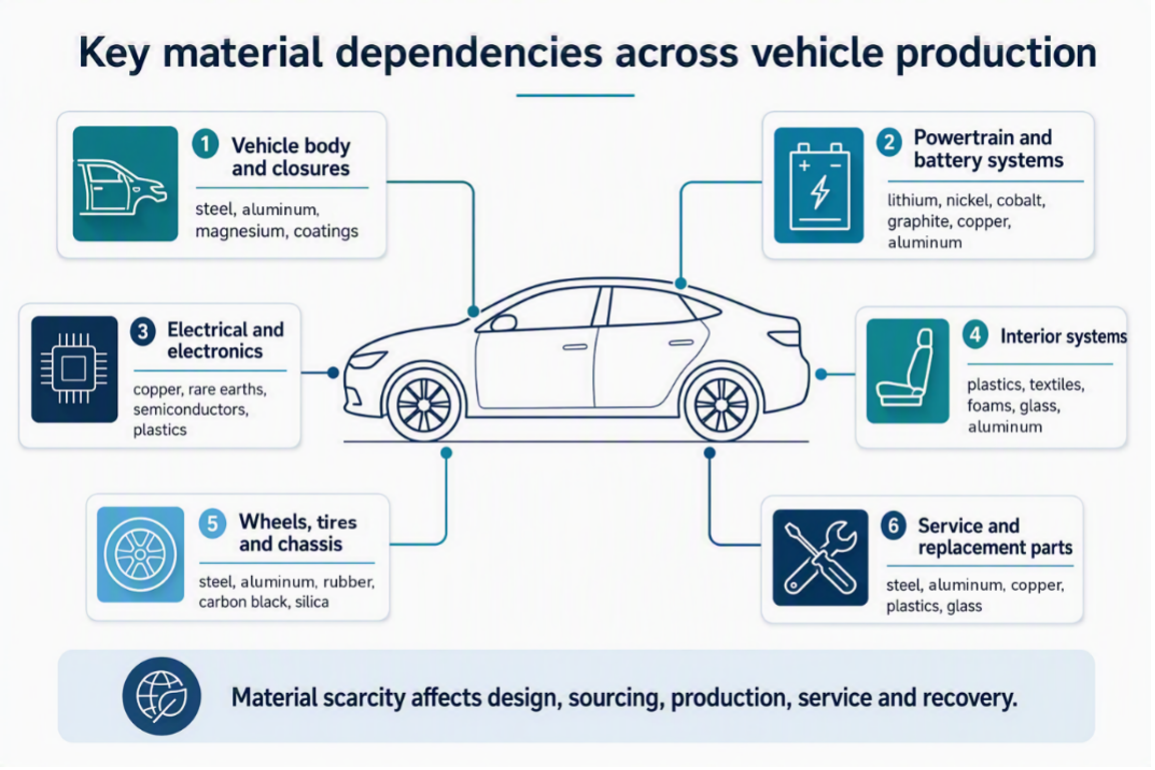
Figure 1: Key Material Dependencies across Vehicle Production
Material scarcity is no longer a peripheral procurement issue for automotive companies; it is becoming a constraint on how vehicles are designed, engineered, produced, and disposed of. Automakers already operate within tight technical specifications, supplier validation requirements, and delivery programs. Scarcity drives up costs and creates unreliable production schedules, which can push companies toward lower-quality alternatives.
The industry-wide transition to lighter, electrified, and more resource-efficient vehicles is reshaping the entire supply chain. In addition to critical minerals, steel, aluminum, copper, and magnesium are also under scarcity pressure, forcing companies to rethink their material strategies.
These materials move through highly specific production and logistics processes. Throughout this value chain, challenges extend beyond raw material production and availability to transport, processing, waste generation, and disposal. Examples of these chokepoints include:
- Lengthy permitting timelines for new mines, which limit access to raw ores and minerals;
- Energy-intensive primary production, which becomes uneconomical where energy is scarce or expensive;
- A limited supply base for specialized components or materials, illustrated by the shock to wire harness supply after Russia’s 2022 invasion of Ukraine. Another example is the Chinese government’s decision in 2021 to curb domestic power consumption, which sharply reduced the production of magnesium. This severely affected European automotive companies, as Europe depended on China for around 95% of its magnesium supply;
- Repair and service demand, which can compete with production for parts, especially during large recall campaigns;
- Trade policies, such as Indonesia’s bauxite export ban, China’s restrictions on critical mineral exports, or US tariffs on imported vehicles and components; and
- National security policies, such as the US Defense Priorities and Allocations System (DPAS), which can require suppliers to fulfill defense orders for critical materials and components ahead of commercial customers such as automakers. A well-documented recent case is the US Army’s use of DPAS to jump the queue for equipment needed to build a domestic heavy rare earth separation facility, requiring suppliers to prioritize that defense project ahead of their commercial customers.
To overcome these challenges, traceability of materials and components throughout the value chain is becoming essential. With better supply chain intelligence, automotive OEMs and suppliers can better anticipate bottlenecks and develop more resilient production processes.
This article shows how incorporating circularity into the supply chain strengthens resilience, and why AI-enabled digital platforms are foundational to making it work at scale.
[1] European industry bodies (ACEA, CLEPA, European Aluminum) cited ~95% dependence on Chinese magnesium in their October 2021 joint call for action
Figure 2: Vehicle Body Materials Supply Chain
The Vehicle Body Supply Chain —
To make these dynamics concrete, the rest of this article focuses on the vehicle body (body-in-white and closures), one of the largest uses of steel and aluminum in a vehicle. As OEMs and suppliers seek to balance performance, cost, and sustainability objectives through strategies such as lightweighting, material choice becomes critical to designing structures that minimize material use while maximizing strength and utility.
However, the yield of automotive-grade materials from current recycling processes is low, primarily due to cross-contamination (e.g., copper from wiring harnesses is melted into steel from car bodies, rendering the recycled steel unfit for automotive use). As sorting and recycling processes improve, recycled material will become a viable alternative to virgin material.
Regulation is accelerating this shift: the EU End-of-Life Vehicles Regulation (ELVR), in force since August 2026, requires new vehicles to contain 15% recycled plastic from 2032, rising to 25% from 2036, with recycled steel and aluminum targets to follow.
Figure 2 shows a typical vehicle body supply chain and where circular loops can return material to production.
[2] https://ucore.com/ucore-receives-a-crucial-dpas-rated-long-lead-equipment-component-at-the-louisiana-smc/
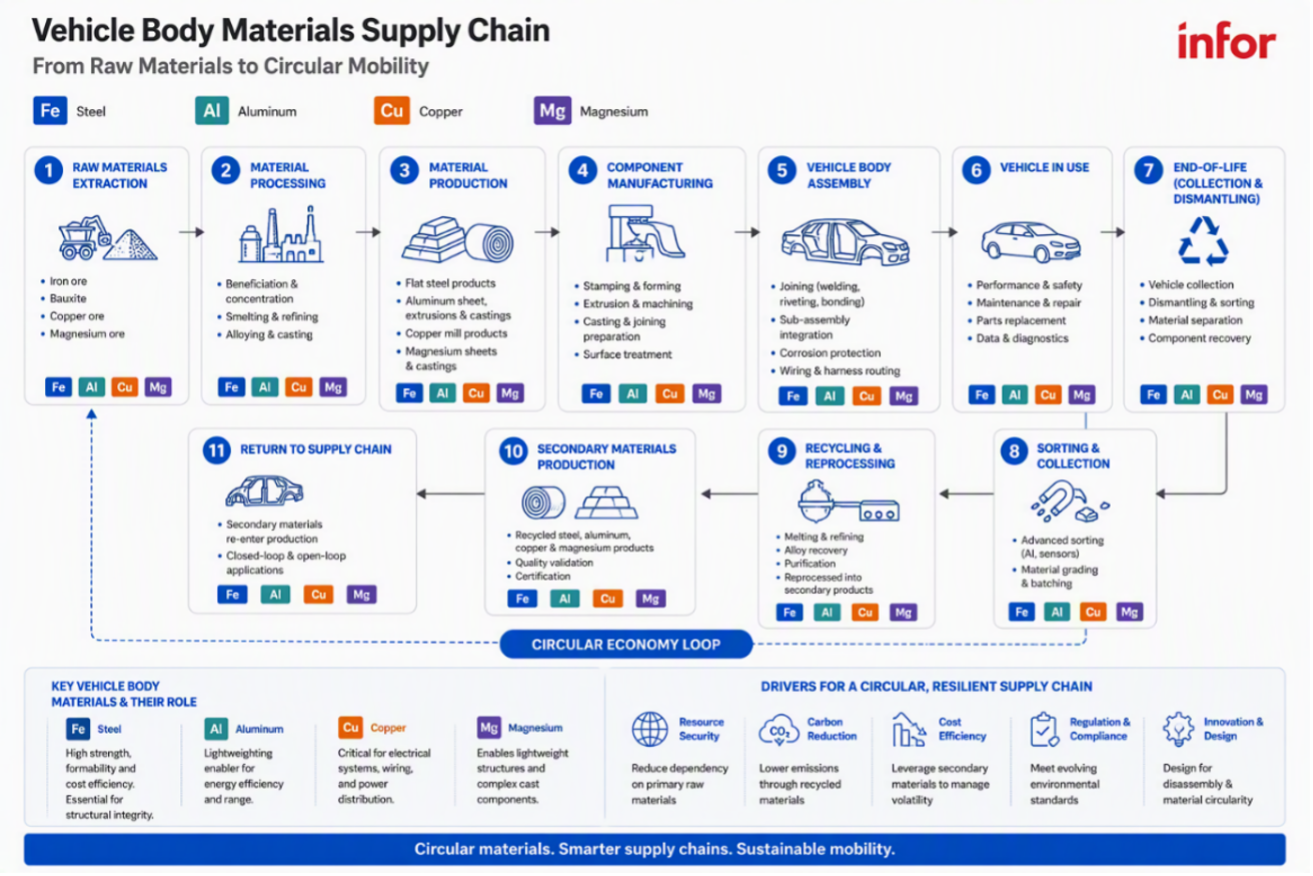
Figure 2: Vehicle Body Materials Supply Chain
How Circularity Strengthens the Response to Scarcity —
1. Circular Design:
A first response is to reduce the amount of material required in the vehicle’s structure. The multi-material body-in-white concept illustrates how design is key to material efficiency. By concentrating high-strength steel in crash-critical load paths, using aluminum where larger panels or closures benefit most from weight reduction, and avoiding unnecessary reinforcements beyond performance requirements, body-in-white weight can be reduced by 40-50% while maintaining structural performance.
Design is also key to reducing primary material use and improving recyclability of End-of-Life Vehicles (ELVs). BMW’s i Vision Circular concept car (2021) shows what this looks like in practice. By avoiding conventional paint finishes, which contaminate the recycling stream, and replacing bonded joints with detachable connections, it allows body materials to be separated cleanly and recycled into new vehicles. This reduces companies’ exposure to primary material supply chains, improves resilience, and can reduce costs by facilitating the use of recycled materials where appropriate.
[3] https://european-aluminium.eu/wp-content/uploads/2022/11/1_aam_body-structures.pdf
2. Reducing Production Waste:
A second response is to reduce production scrap. Body panel stamping alone can turn 30–40% of incoming sheet into offcuts, and casting, extrusion, and machining add further residues and rejected parts, particularly when aluminum and steel are processed at scale. Reducing and recapturing scrap therefore directly eases pressure on primary material demand.
For the Qashqai, Nissan introduced a closed-loop process in the press shop at its Sunderland plant in the UK, where aluminum offcuts are extracted and separated so that high-quality scrap can be returned to material suppliers and remade into automotive-grade sheet. This not only reduces waste but also designs the production process itself to keep valuable metal in the loop.
3. Replacing Primary Materials:
OEMs and suppliers can also substitute constrained primary materials with different materials where engineering trade-offs can be managed. Carbon-fiber-reinforced plastic (CFRP) can replace some conventional steel-intensive body structures while delivering the required stiffness at lower weight. By using CFRP for the passenger cell, BMW’s i3 (2013–2022) reduced dependence on conventional metal-intensive body construction and helped offset the additional weight of the battery pack.
However, substitution supports circularity only if end-of-life is designed in from the start: CFRP is energy-intensive to produce and difficult to recycle back into structural-grade material. Circularity considerations must therefore be built into the product design and engineering specification phases.
4. Supply Chain Agreements and Partnerships:
OEMs and suppliers are entering supply chain agreements and partnerships to secure access to constrained materials and processing capacity. For example, in 2025, GM signed a multi-year agreement with Noveon Magnetics for the supply of rare earth magnets.
While such agreements can strengthen access to primary raw materials or critical components, companies may become too reliant on specific suppliers, limiting their resilience to potential disruptions. Developing a multi-supplier strategy where feasible can help mitigate this risk.
An early example of a circular supply partnership is the 2012 multi-year agreement between Jaguar Land Rover (JLR) and Novelis, making Novelis the sole supplier of automotive aluminum sheet to JLR, with a built-in recycling commitment where Novelis recovers and recycles all of JLR’s aluminum production scrap, creating the closed loop. In September 2017, JLR extended the model with the REALITY project, pushing the closed loop beyond manufacturing scrap to aluminum recovered from end-of-life vehicles, sorted and graded, remelted by Novelis, and returned as body sheet for new JLR vehicles.
Beyond reducing primary material costs, recycled aluminum requires up to 95% less energy than primary production, supporting sustainability targets.
Partnerships like this, which address resilience at every level of the supply chain, can help OEMs and suppliers ensure stable supplies, meet production targets, and protect revenue and margin.
[4] https://novelis.com/case-studies/jaguar-land-rover/
[5] https://www.prnewswire.com/news-releases/driving-american-industry-general-motors–noveon-magnetics-sign-multi-year-agreement-to-deliver-american-made-rare-earth-magnets-302522804.html
5. Vertical Integration:
Some manufacturers are going further by increasing direct control over the processing and production of critical materials and components, not only to ensure supply chain resilience, but also to expand into new market segments. An example of the former is GM’s 2023 investment of $650 million in Lithium Americas to secure lithium supply from the Thacker Pass project in Nevada.
An example of the latter is Blue Bird Corporation’s August 2026 agreement with Ford to design, build, and sell the next-generation F-53/F-59 commercial stripped chassis, including the acquisition of the Detroit assembly assets of Detroit Chassis LLC (DCP), the long-time manufacturer of these chassis.
Blue Bird sees the commercial stripped-chassis market as a major diversification beyond school buses: roughly 10,000 units and $600 million in annual revenue potential, a $1.4 billion expansion of its addressable market, and entry into the RV Class A, step-van, and last-mile delivery segments.
To minimize compliance and regulatory risks, such vertical integration can be strengthened with digital material traceability. For example, Hyundai CRADLE Tel Aviv and SMX have partnered on a proof of concept for “material memory”, a technology that embeds molecular markers in materials and links them to a blockchain-backed digital registry, enabling raw materials to carry a verifiable identity from manufacture through recycling.
The first phase, focused on automotive polymers, successfully delivered a digital identity layer enabling lifecycle visibility and Digital Product Passport readiness. The next phase extends the proof of concept to aluminum and steel, toward a unified multi-material traceability framework for Hyundai Motor Group. At scale, this approach could help Hyundai achieve greater supply chain stability, meet sustainability goals, and drive additional cost and margin improvements.
Together, these examples show that circularity is best achieved when embedded across the vehicle’s or component’s lifecycle, by linking circular design, production scrap management, material substitution, supplier partnerships, and vertical integration into a more resilient value stream. Crucially, the success of these efforts depends on reliable data, modern technology, common standards and coordination, not only across the organization but across the entire ecosystem of suppliers, partners and customers. Without these, circularity initiatives risk remaining isolated efforts rather than a scalable response to material constraints and a driver of additional economic value.
[6] https://media.jlr.com/corporate/en-us/news/2017/09/cars-reborn-new-aluminium-recycling-scheme
[7] https://lithiumamericas.com/news/news-details/2025/Lithium-Americas-Reaches-Agreement-with-GM-and-U-S–DOE-Regarding-First-Draw-on-DOE-Loan/default.aspx
[8] https://www.stocktitan.net/sec-filings/BLBD/8-k-blue-bird-corp-reports-material-event-f09488e76f5d.html
[9] https://lnkd.in/p/gRQfgSeA
How AI-enabled, Data-driven Digital Platforms Can Operationalize Circularity at Scale —
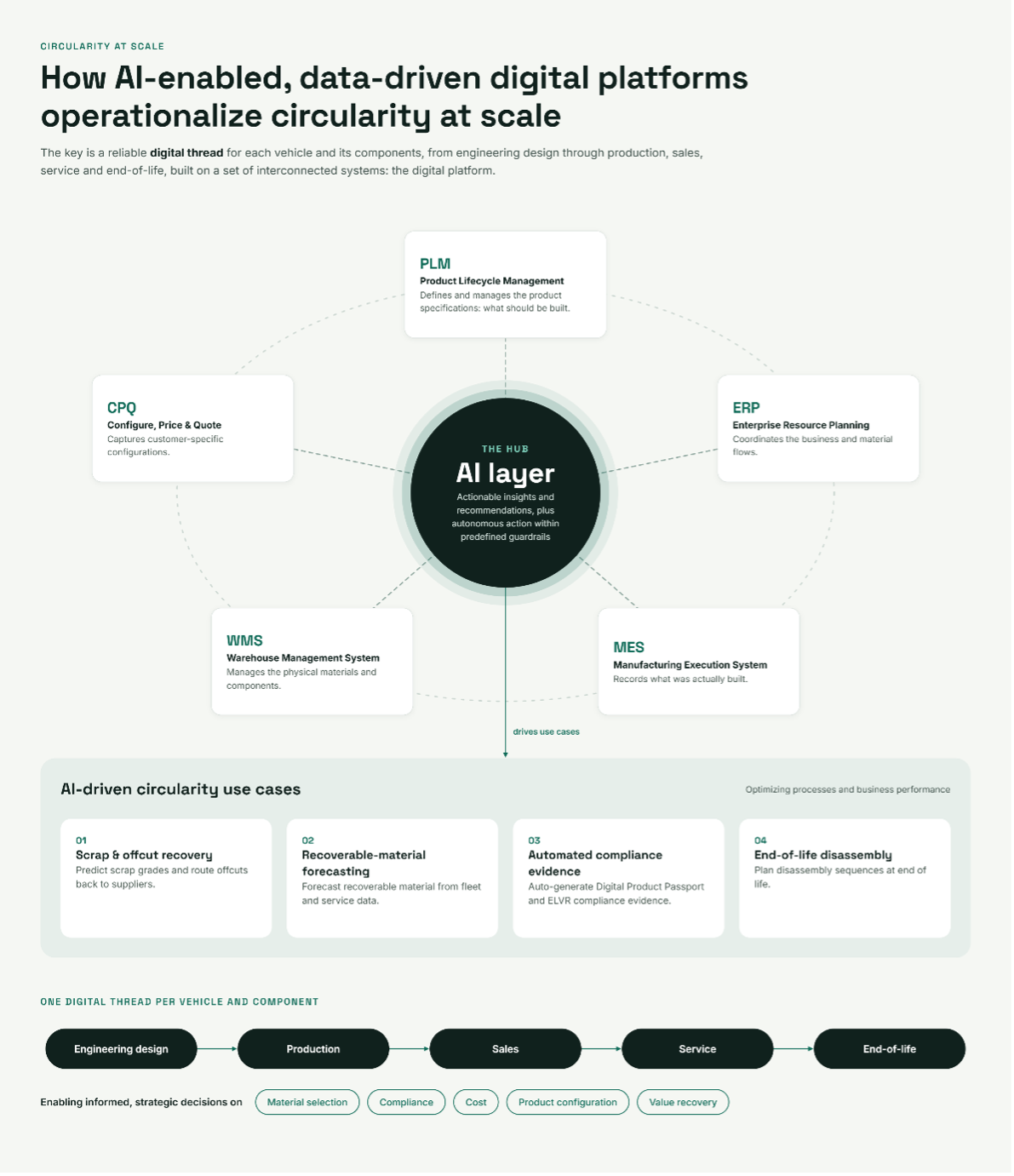
The key to achieving circularity at scale is to maintain a reliable digital thread for each vehicle and its components, from engineering design through production, sales, service, and end-of-life. This enables companies to make informed and strategic decisions about material selection, compliance, cost, product configuration, and value recovery.
The digital thread is built on a set of interconnected systems (the digital platform), including:
- Product Lifecycle Management (PLM), which defines and manages the product specifications and what should be built;
- Enterprise Resource Planning (ERP), which coordinates the business and material flows;
- Manufacturing Execution System (MES), which records what was actually built;
- Warehouse Management System (WMS), which manages the physical materials and components;
- Configure, Price and Quote (CPQ), which captures customer-specific configurations; and
- An AI layer, which provides actionable insights and recommendations, and can act autonomously within predefined guardrails to optimize processes and improve business performance. Some AI-driven use cases include: predicting scrap grades and routing offcuts back to suppliers; forecasting recoverable material from fleet and service data; auto-generating Digital Product Passport and ELVR compliance evidence; and planning disassembly sequences at end of life.
Here is an infographic explaining the relationship between the types of systems (e.g., ERP) and AI use cases.
Together, these systems preserve circularity-related information across the production and product lifecycle, for example:
- At program launch: verify material and design choices, calculate costs, and substantiate circularity claims;
- During production and vehicle or component use: know what materials and components went into a specific vehicle and track repairs or replacements; and
- At end of life: identify components that can be reused, remanufactured, or recycled, then return recovered materials back into the supply chain.
To achieve this level of digital maturity, organizations must:
- Establish a secure, modern technical architecture built around a data-driven, AI-enabled platform that incorporates industry-specific processes;
- Break down organizational, functional, and technical silos so that information flows seamlessly within the enterprise and across the ecosystem, improving the speed and accuracy of decisions;
- Treat data quality as non-negotiable;
- Make the organization ‘digital first’, upskilling and hiring to build digital fluency;
- Demonstrate a direct link between circularity initiatives, customer satisfaction and business performance;
- Agree on data standards for material passports with key suppliers; and
- Secure sustained executive sponsorship to drive the change.
Three Tensions Leaders Must Manage —
Circularity is not a free lunch. Leaders who pursue it should plan for three tensions:
- Time lag: Vehicles stay on the road for well over a decade, so recovered end-of-life material cannot keep pace with today’s demand growth. In the near term, the biggest gains come from production scrap and closed-loop supplier agreements, not from recovered vehicles.
- Lightweighting versus recyclability: Multi-material bodies and composites such as CFRP save weight but are harder to separate and recycle. Design teams need explicit trade-off rules, not just weight targets.
- New forms of dependency: Closed loops often rely on a single partner, as in JLR’s sole-supplier arrangement with Novelis. Circularity reduces exposure to primary markets but can concentrate counterparty risk, so it should complement, not replace, a multi-supplier strategy.
Conclusion —
Automotive material and supply chain risk can no longer be managed through conventional sourcing alone. Steel, aluminum, copper, magnesium and rare-earth components are constrained across mining, energy-intensive primary production, component manufacturing, assembly, repair and transport. Geopolitical instability adds another variable to the mix.
These pressures do not stay upstream; they directly affect validation, launch readiness, volume production, spare parts and aftermarket serviceability. OEMs and suppliers are therefore beginning to respond using a broad set of measures that reduce material use through design, recapture production scrap, substitute hard-to-get primary materials with suitable alternatives, build supply chain partnerships and integrate operations vertically.
Circularity strengthens these responses by shifting the focus from potentially disconnected, ad hoc initiatives to a managed material value chain across the vehicle or component lifecycle. By incorporating circular practices into business operations, automotive companies can build greater resilience to supply chain shocks. These measures, however, cannot be executed without reliable data, common standards, intra- and inter-enterprise collaboration, and a cyber-resilient, agile, and modern digital backbone.
Despite regional differences in regulation, the direction of travel is clear, and OEMs and suppliers should plan accordingly. Circularity is no longer a compliance cost or a sustainability overhead. Aligned with business objectives and supported by the right organizational, technology and process foundations, it becomes a driver of competitive advantage: the companies that build these capabilities first are likely to secure materials, and margin, that slower competitors cannot.
Contact Us —
One proven way to manage scarcity and circularity in automotive plants, both OEM and tier suppliers, is to have an industry-focused ERP solution specifically for automotive and parts manufacturers. For more information, see this link for the PCG Infor ERP solutions, including CloudSuite Automotive: https://pcgservices.com/automotive-solutions/
Also, for webinars, podcasts and demo videos of our automotive industry solutions, visit our PCG Insights HUB for Automotive industry. https://automotive-erp-videos-infor-ln-cloudsuite-automotive.hubs.vidyard.com/
Here is the author Peter Maithel’s LinkedIn profile: https://www.linkedin.com/in/petermaithel/
Contact PCG at pcgservices.com or email at info@pcgservices.com. And thank you for reading our Insights BLOG. More are available at https://pcgservices.com/blog/
[10] https://environment.ec.europa.eu/topics/waste-and-recycling/end-life-vehicles_en
///
Work together with PCG for great Infor platform success. Contact us, and let’s get started!
NOTE: All references to external content, motion pictures, actors, or third-party story lines does not represent an implied or explicit relationship with any third-party content owner. All trademarks, tradenames, movie titles, scripts and story lines, and NIL remain the property of their respective owners.
More Information for You





Solutions
Services
Support
Platforms
Technology Partnerships




Contact | Legal | Privacy Policy | LinkedIn | YouTube | SmartFactory | OrangeQuery | AskQ
