
Insights Blog
ERP vs. MES
What’s the Difference, and Why Manufacturers Need Both
Author: Dan Aldridge — PCG Director of Solutions Marketing
Executive Summary —
Enterprise Resource Planning (ERP) software has been the standard for running businesses across all industries and in most sizes since the 1990’s, when the term was coined by ERP pioneers Jan Baan (Baan Company) and Dr. Hasso Plattner (SAP).
ERP manages broad, enterprise-wide business processes like finance, warehousing, and supply chain. ERP is essential for manufacturing and distribution companies of any size because it controls process flows such as sales order-to-cash and procure-to-pay in addition to providing a “system of record” for financial transactions, as in the general ledger (GL).
ERP can be used for high-level production planning and basic execution, such as issuing materials or recording actual hours tied to a production order. It was never designed, however, to communicate directly with Operational Technology (OT), sensors, machines, and operating systems on the shop floor.
In this article, we will learn more details about what ERP does well and where its limitations lie in solving manufacturers’ shop floor execution challenges.
A Manufacturing Execution System (MES) is designed to establish this direct communication with OT and manage the “shop floor” in real time. In this article, we will learn more details about MES, what it does, and how it bridges the gap between the “top floor” of high-level control, which is the dominion of ERP, and the factory, which is where MES shines.
At PCG, we believe that MES is significantly better software for managing real-time production execution and quality control on the shop floor. That is not to say that ERP doesn’t have a role in manufacturing operations – just that MES can complement ERP and pick up where ERP leaves off.
The Bottom Line: ERP runs the business; MES runs the factory!
The Smart Manufacturing Maturity Model —
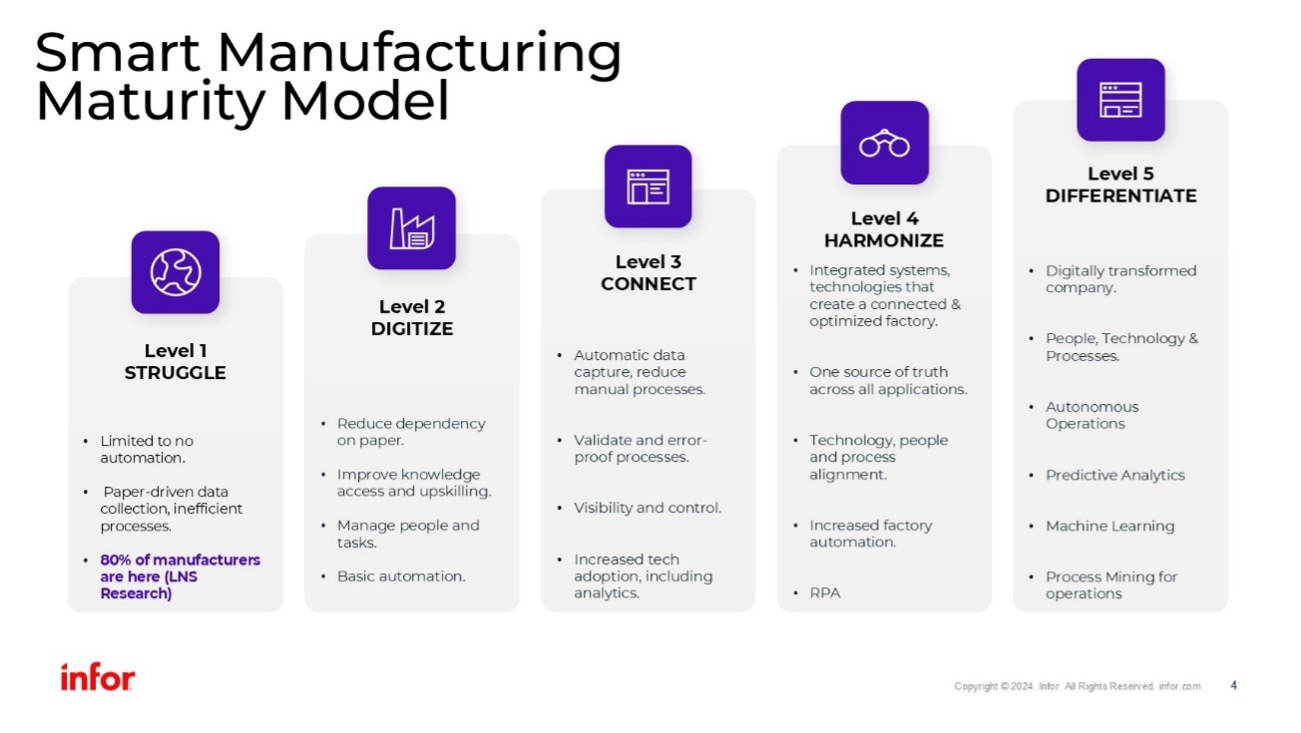
Research suggests that there are different levels of maturity for companies looking to move closer towards smart manufacturing, which typically includes both types of systems in the mix: ERP and MES. The problem, though, is that many manufacturing companies are stuck at Level 1 (Struggle) – in fact, over 80% according to LNS Research.
Learn more about Smart Manufacturing by clicking here
At Level 1, even if an ERP is already in place, manual paper logs and shop travelers are often used on the shop floor. And machines, while they might have Programmable Logic Controllers (PLCs) in place, typically haven’t been connected to the ERP systems. There is paper-driven and spreadsheet data collection everywhere, and companies are stuck there.
So, what should be done and how can companies aspire to the higher levels of the Maturity Model?
Here’s a quote from the excellent article ‘ERP vs MES: What’s the Difference & Why You May Need Both’ by Michell Shostko-Datch at VKS.
“In today’s fast-moving manufacturing world, companies need more than spreadsheets or disconnected software to stay competitive. They need systems that help them plan work, execute work, and understand what’s happening across the entire production process. This needs to happen at both the business level and down on the shop floor.”
The article suggests that systems need to replace spreadsheets, disconnected software, and (it goes without saying) manual processes. But what type of system is best to handle the “business level” and what type should handle the “shop floor”?
Setting the Stage —
Before we explore the differences between the two types of systems and why manufacturers might need both, let’s understand what ERP and MES are in more detail.
We argue that in a manufacturing company, the business system has to be an ERP for any company, of any size. And no – QuickBooks and spreadsheets together are not an ERP system.
So, we’ll discuss ERP first, then MES, then compare the two. Finally, we’ll make the case for using a combination to handle the shop floor.
Fortunately, together these two types of systems can make beautiful music. When you add a modern MES like our PCG SmartFactory to a really good cloud ERP, it’s really something special for companies that truly want to reach the goal of Level 5 in Smart Manufacturing Maturity.
What Is an ERP System? —
Enterprise Resource Planning (ERP) systems are the backbone for high-level business management in virtually any-sized company. It is typically considered a “back-office” system, as people in departments like Finance and Purchasing use it, and they are not “customer-facing”.
ERP has some manufacturing functionality, but as we’ll discover in this article, ERP for shop floor operations is often insufficient in relatively complex manufacturing environments.
Typical ERP modules include:
- Finance and Accounting – Report on financial performance, financial statements, financial budgets, invoice processing, cash management, etc.
- Sales and Customer Service – Process sales quotations, create sales orders, monitor inventory, and check fulfillment schedules for shipping.
- Enterprise Planning – High-level planning of a product forecast, master production schedule (MPS), and production plan at the production/work order level.
- Inventory Management – Monitor stock levels, reorder points, and warehouse operations, including receiving, shipping, and material issue.
- Procurement – Oversee purchasing and supplier management, including supplier portals, and dealing with exceptions to PO vs purchase invoice matching.
- Shop Floor Control – Once production/work orders have been created, basic functionality like material issue and recording labor hours is available in the ERP, although it’s not ideal for sophisticated manufacturers (which is where MES comes in).
- Human Resources – Manage employee data, time tracking, and payroll. Some of this data, such as paid hours, can be compared to “absorbed” or “earned” hours for hourly workers on the shop floor.
For manufacturers, ERP plays a vital role in planning, forecasting, and resource allocation. Typically, it doesn’t manage detailed hour-by-hour production tasks, such as labor and machine reporting – or, at least, not as well as some other technologies.
ERP provides the data and structure needed to guide operational decisions from the “top down”. It provides all the orders and transactions that contribute to financial accounting, so it is the “one version of truth” for all financial reporting and some operational reporting as well.
Where ERP is Limited: Shop Floor Execution —
At the beginning of ERP in the ‘90s and early 2000s, manufacturers were often persuaded that ERP was the only transactional system that they needed. Once they got the basic functions under control, however, they began finding that ERP was clumsy to use on the shop floor with computer terminals and laptops, and it slowed the lines down.
Production order information was often entered into desktop computers in offices at the end of the day. Materials were pulled without recording issues in the system. Traceability meant writing notes on “shop travelers”, which meant paper! This all added up to manual processes, frequent mistakes, and sometimes grossly inaccurate information to manage manufacturing operations. In other words, needless pain.
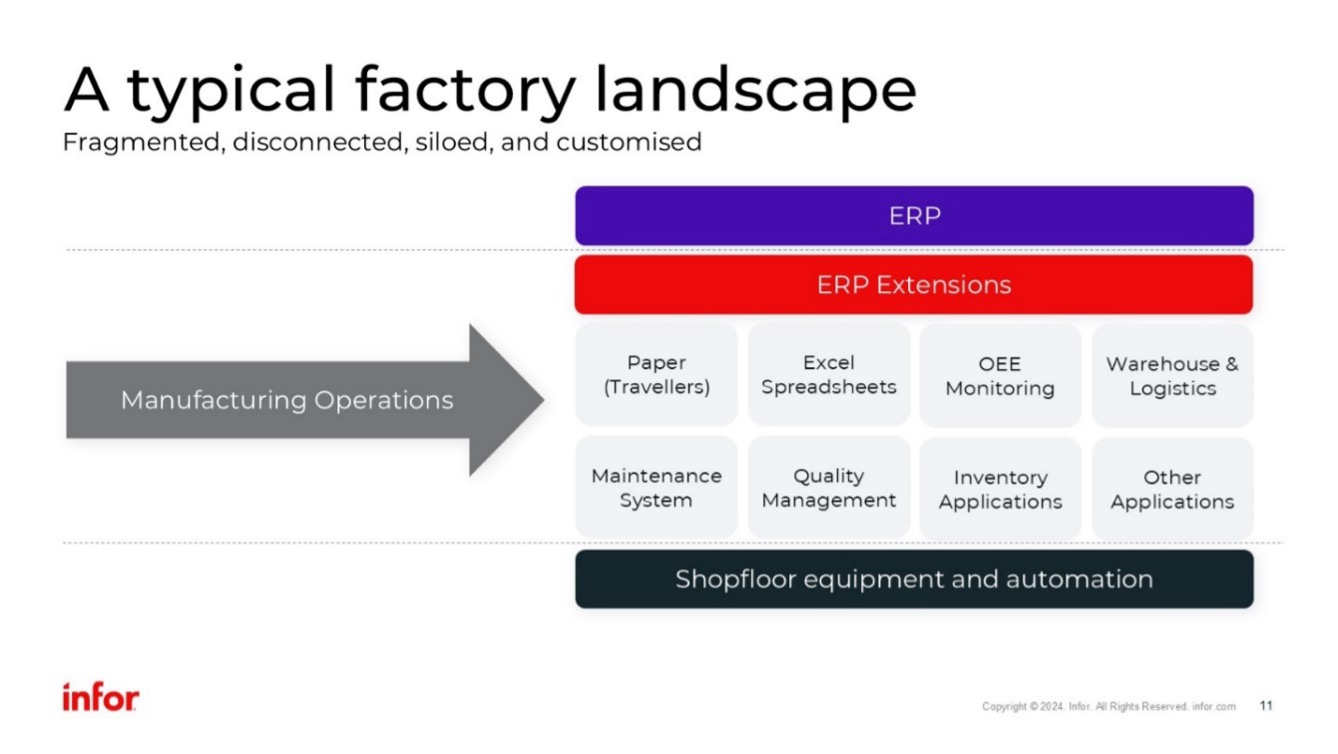
As the diagram below shows, travelers were combined with Excel spreadsheets and manual monitoring of KPIs, like Overall Equipment Effectiveness (OEE), because there was no connection between the ERP at the high level and the shop floor equipment and automation at the low level.
Learn more about Infor ERP by clicking here
Companies tried to customize the ERP systems (i.e., building ERP Extensions) in the shop floor control and quality management modules, only to find they still couldn’t connect ERP directly to the shop floor equipment or assets. That meant they couldn’t take advantage of technology advances there either.
Although Manufacturing Execution Systems (MES) also debuted in the ‘90s, like the larger ERP systems, they didn’t really come into vogue until they could easily connect to shop floor equipment, fixed assets, and ERP systems.
In the 2000s, advances in the Internet of Things (IoT), sensors, machines with wireless connections, statistical process control (SPC), and other technologies led to the evolution of the modern MES System.
So, what is modern MES, and how does it compare with and complement ERP?
What is an MES System? —
Manufacturing Execution Systems (MES) operate on the shop floor. Once a production/work order has been released from ERP, as part of the big picture production plan, MES focuses on the minute-by-minute flow of production.
Unlike ERP, MES systems are designed to monitor, control, and optimize manufacturing processes in real time. They bridge the gap between enterprise-level planning and physical production execution – without customization.
Key MES functions include:
- Production Tracking – MES monitors production or work orders, operations, and progress in real time as opposed to ERP, which is typically batch-driven with aggregated information. After ERP issues production/work orders into MES, MES can do the whole order and quality processing without any operational users having to touch ERP. This is a huge advantage over ERP alone!
- Machine Integration – MES connects to IoT (Internet of Things) devices, PLCs, sensors, and automation systems to capture performance data such as OEE. Some of that performance data, such as machine time, can be communicated back to the ERP…automatically.
- Traceability – MES captures who is working on what order, what they’re working on, when they’re clocked in, and how every unit is produced. This traceability is important for compliance, such as lot control for the FDA, and management of jobs.
- Scheduling – MES allocates work orders (jobs) to machines and workers with dynamic scheduling tools. The best MES systems in the market today have Advanced Planning and Scheduling (APS) with constraints built in, whereas many ERPs are still “unlimited capacity – i.e., unrealistic.
- Quality Management – MES tracks inspections, scrap, rework, defects, and compliance on the shop floor. Although most ERPs have a quality control module that can do just basic inspection orders, MES adds user-friendly test scenarios and inspection steps/parameters that can be easily performed on tablets and handheld scanners.
An MES helps manufacturers maintain control, ensure quality, and respond quickly to issues as they arise. It’s built for operators, supervisors, and plant managers who need live feedback and more precise control over daily operations than ERP can provide.
How MES Picks Up Where ERP Struggles —
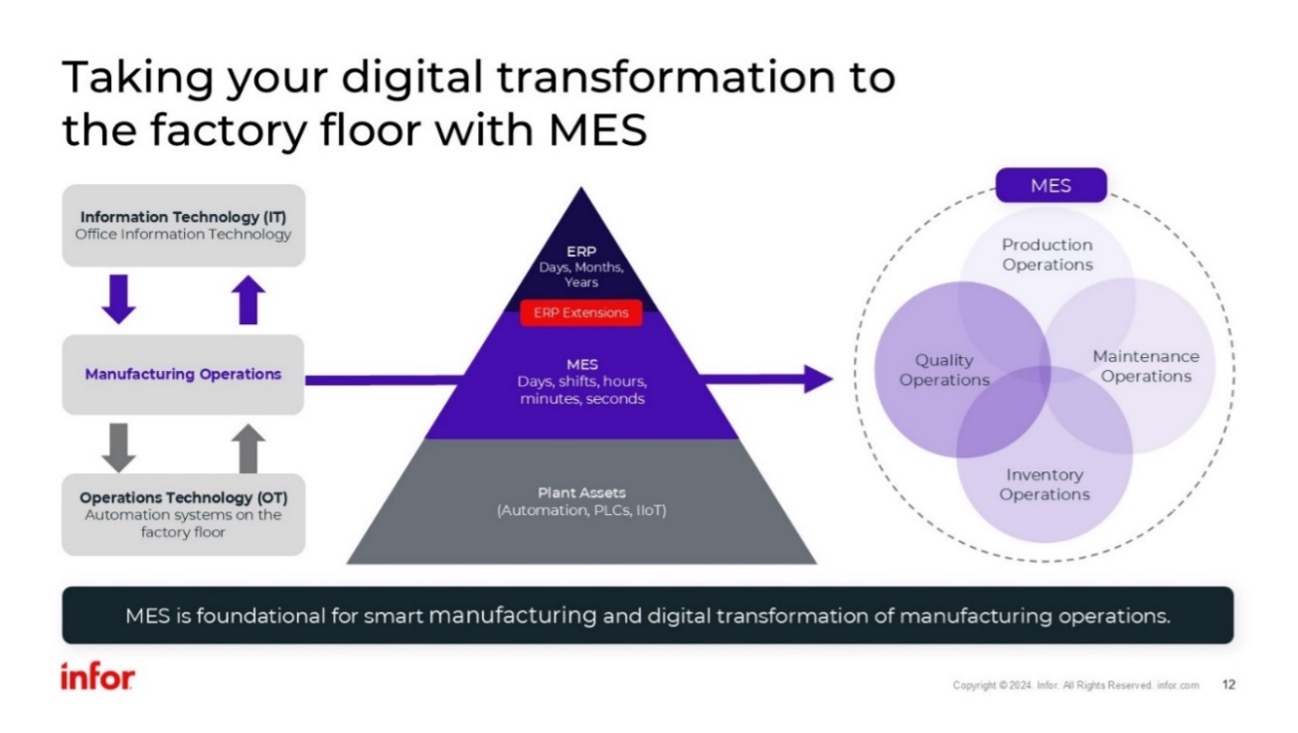
Where ERP measures in aggregated days, months, and even years, MES allows measurement in shifts, hours, minutes, and even seconds. This is what is needed on a factory floor because conditions are changing constantly – and ERP alone, even with customization, can’t keep up.
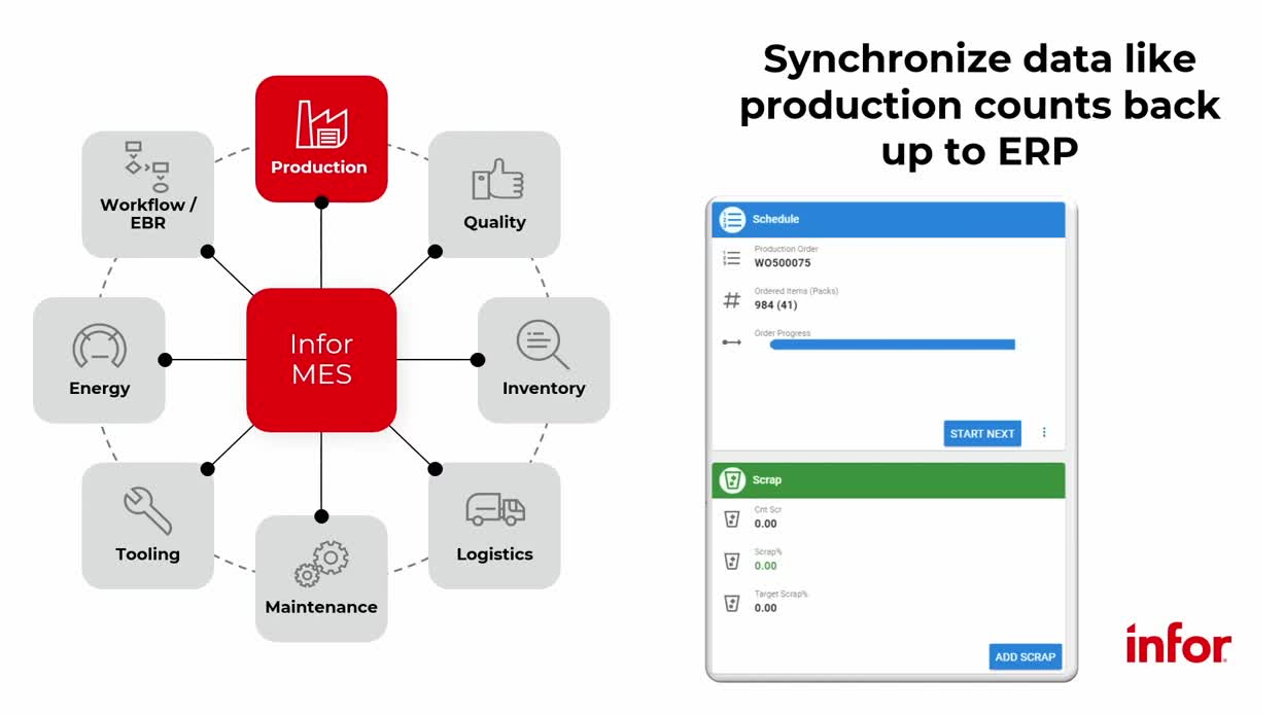
Here’s an excellent video demonstrating how a top-ranked MES system, Infor MES, deftly handles the shop floor – basically in real time.
What are the Primary Differences Between ERP and MES? —
The basic difference between the two types of systems is that ERP plans and executes the business, while MES executes the shop floor. Here is a breakdown of the primary differences between Enterprise Resource Planning (ERP) and Manufacturing Execution Systems (MES).
The VKS article quoted above did a nice job of summarizing the high-level differences between ERP and MES, and we added more detail to each point.
High-Level Differences:
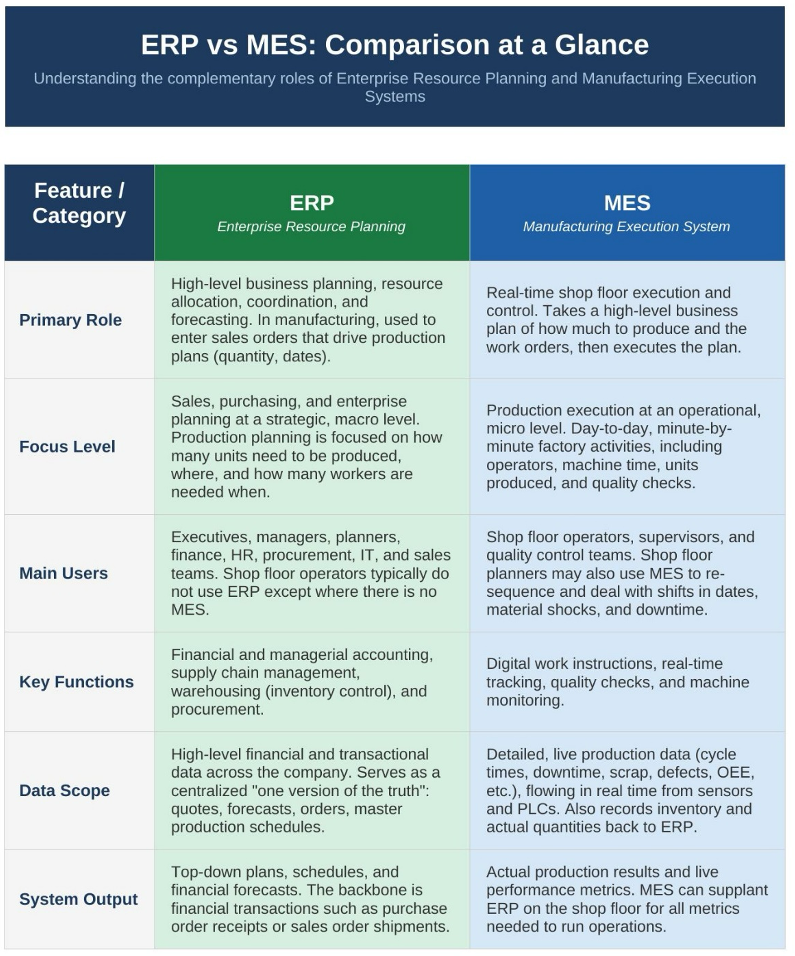
- ERP (Enterprise Resource Planning): Think of the ERP as the “high-level planner.” It operates at strategic and business levels, managing high-level transactional data across the entire organization, including finance, HR, purchasing, and sales.ERP can schedule production on a macro scale, such as a list of production orders with dates for sequencing overall, but it doesn’t know what is happening minute-by-minute at individual cells or workstations.
- MES (Manufacturing Execution System): Think of the MES as the “execution engine.” It operates at the tactical shop-floor level, managing, monitoring, and controlling physical production processes in real time.MES can also schedule production, but it does it on a micro scale. So, it does get down to sequencing orders, machines, and operators to generate a minute-by-minute detailed schedule at individual cells and workstations.
This table compares ERP and MES “at a glance”.
How They Work Together —
Even though they are different, rather than competing, these two systems are highly complementary. In a modern smart factory, they form an interconnected information loop:
1. The ERP Sets the Production Target: The ERP determines what needs to be built, when it needs to be delivered, and what resources are allocated. It then sends these high-level work orders down to the shop floor.
2. The MES Drives the Shop Floor Work: The MES takes that production/work order and guides operators through step-by-step work instructions, enforces quality checks, and captures live production (e.g., assembly) data.
3. The Connected Loop: The MES automatically updates the ERP with actual quantities produced, scrap rates or units, and time spent – both operator and, if needed, machine hours. This allows management to monitor inventory and machines in real time and adjust future forecasts with accuracy.
As MES expert Matt Barber says in his MES Matters Blog: “Implement MES to remove complexity from your ERP”:
“MES is specifically built to manage and control manufacturing operations, capturing real-time data from the shop floor and translating it into actionable insights. It acts as a bridge between the shop floor and the ERP system, enhancing the capabilities of both. By integrating MES with ERP, companies can achieve a seamless flow of information and reduce manual data entry and reconciliation efforts.” – Matt Barber, MES Matters
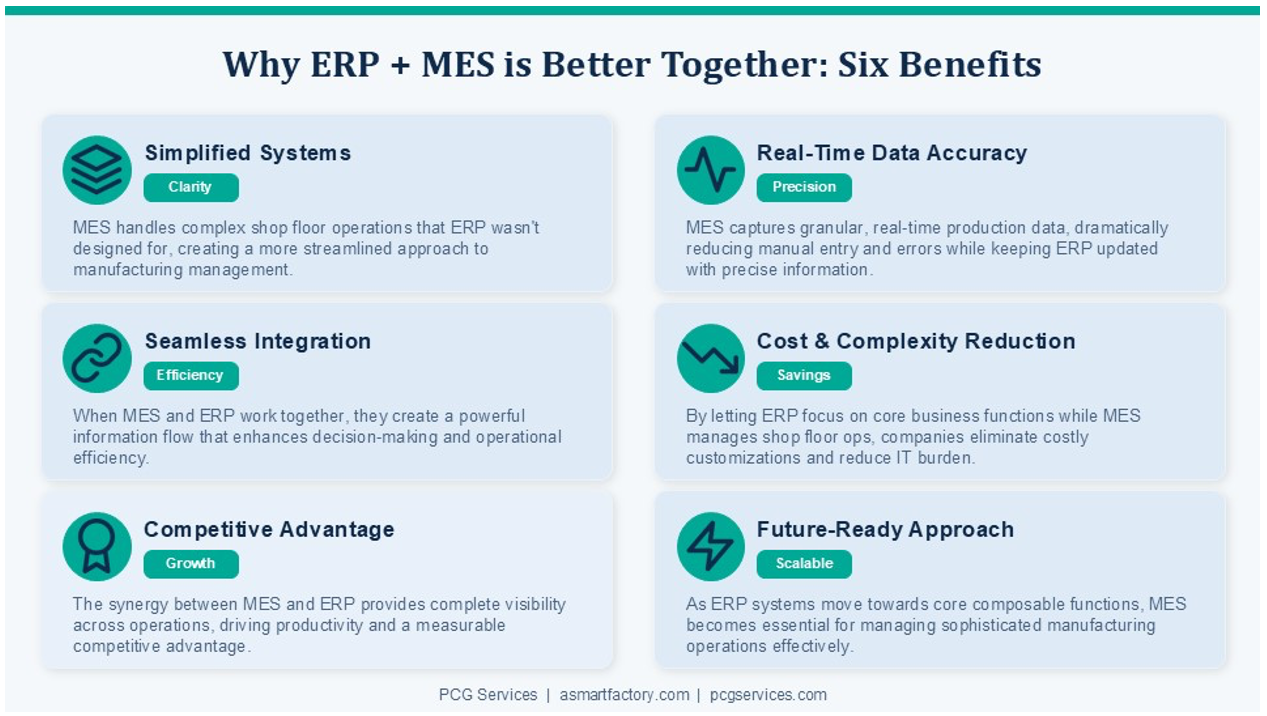
The relationship between ERP and MES is often misunderstood, yet it’s crucial for modern manufacturing success. Here’s why they need to work together, and how they complement each other.
Here’s an infographic that presents six reasons why ERP is better when MES is added. Matt Barber deserves credit for the words, and we made an infographic to display them!
5 Ways ERP Contributes to Production —
ERP issues the production/work orders to the shop with the estimated materials, coming from the bill of materials (BOMs), and the estimated hours per operation, coming from the routing and engineering.
So, by itself, ERP can provide only:
1. Limited raw materials and WIP visibility
2. Work order scheduling and high-level production plan
3. Basic work list per work center
4. Minimal contribution to UI as ERP was not designed for operational users
5. Manual data collection from shop floor equipment
10 Ways MES Complements and Enhances ERP —
MES is a huge boost to ERP for shop floor control because it can receive production/work orders from ERP and allow shop floor users to execute production easily. This includes recording actual labor hours per operation, taking the machine hours per operation from the machine controllers, and displaying production KPIs like OEE that otherwise (with ERP alone) must be recorded manually.
MES does this because it can provide:
1. Connection to PLCs and other sensors via IoT
2. Traceability, including quality checks and tooling
3. Real-time visibility and control
4. Error-proof business processes
5. Connection to quality gauges
6. Real-time Statistical Process Control (SPC) analysis
7. Capture of energy data for Environmental, Social, and Governmental (ESG) initiatives
8. Operational data for AI/ML
9. Generative AI predictive analytics that are built into core MES
10. Asset care and tool management
8 Immediate Benefits and Cost Savings of ERP and MES Working Together —
Together, ERP and MES provide the ultimate combination to achieve:
1. Increased productivity & efficiency
2. Increased plant output & capacity
3. Reduced WIP, accurate traceability
4. Improved quality, reduced scrap/rework
5. Faster issue resolution
6. Improved visibility and control
7. Increased on-time in-full (OTIF) delivery
8. Better predictive analytics using AI that can pinpoint critical failure points like machine downtime
Conclusion —
What’s the Problem?
Every manufacturer aspires to achieve Level 5 in the Smart Manufacturing Maturity Model, but the vast majority are stuck on Level 1. Almost all manufacturers have some sort of manufacturing ERP system in place, although many of these systems are old and even obsolete for a variety of reasons, including that they are heavily customized, limited in functionality, and so on. So, users have reverted to manual workarounds and siloed processes.
Bottom Line: ERP is, almost always, not enough to handle operational and shop floor processes properly!
What’s the Difference Between ERP and MES?
ERP is the “high-level planner.” It operates at strategic and business levels, managing high-level transactional data across the entire organization, including finance, HR, purchasing, and sales.
Although ERP can schedule production on a macro scale, such as a list of production orders with dates for sequencing overall, it doesn’t know what is happening minute-by-minute at individual cells or workstations.
In contrast, MES is the “execution engine.” It operates at the tactical shop-floor level, managing, monitoring, and controlling physical production processes in real time.
MES can also schedule production, and unlike ERP, it can do it on a micro scale. So, it does get down to sequencing orders, machines, and operators to generate a minute-by-minute detailed schedule at individual cells and workstations.
Why Do Manufacturers Need BOTH?
Any manufacturer of any size has an ERP that, to a large extent, covers the core “top floor” and admin processes like sales, purchasing, warehousing, and finance. If they don’t have an MES, though, the shop floor execution is almost certainly plagued by manual processes, delayed time entry, human mistakes (i.e., bad data), and so on.
With bar coding, handhelds, wireless scanners, connections to machines via wireless controllers, and many other features, adding an MES to the ERP will result in an immediate boost to at least Level 3 in the Maturity Model. It’s the only way we know to get fast, dramatic gains in efficiency, cost savings, processes, and data by implementing a single additional piece of technology!
Recommended Reading —
- VKS: ERP vs MES: What’s the Difference & Why You May Need Both’ by Michell Shostko-Datch
- Parsec: MES vs. ERP: The Guide to Manufacturing and Enterprise Systems
- Maveneer: MES vs ERP: Understanding the Differences
- GE Vernova: MES vs ERP: What’s the Difference?
- MES Matters Blog: Implement MES to remove complexity from your ERP, Matt Barber, Infor https://www.mesmatters.com/post/implementing-mes-can-simplify-your-erp
- MES Matters website (multiple great articles): https://www.mesmatters.com/
Useful Links —
At PCG, we help manufacturers understand how ERP, MES, and SmartFactory should integrate to enable true smart manufacturing. Through many combined ERP and MES projects, we have seen in practice how aligning the two can unlock breakthroughs and transformational value.
PCG has a variety of resources for those interested in how ERP and MES can work together to help manufacturers thrive in an uncertain and challenging environment.
Useful Links:
- You can find out more from our websites for PCG services and solutions including ERP and MES at com and for SmartFactory at asmartfactory.com.
- Our Infor ERP page for Infor CloudSuite Industrial (CSI/SyteLine) and Infor Cloudsite Enterprise (CSIE/LN) is here.
- The MES systems we use, Infor MES and SmartFactory, are tightly integrated to the ERP systems we use, which are Infor CSI (CloudSuite Industrial), Infor LN (CloudSuite Enterprise), and NetSuite.
- If you have Infor SyteLine or LN on premises, then we sell and implement Infor MES (formerly Lighthouse). Here’s our Infor MES page.
- If you have CSI or CSIE, we have our PCG SmartFactory which integrates seamlessly with both – the only solution in the market that can do it! Our dedicated SmartFactory MES page is here.
We have also developed a 400+ video library that we call the PCG Insights HUB. Here’s a link to the main PCG Insights HUB page where you’ll find tiles to see demo videos by product (e.g., NetSuite ERP), by industry (e.g., Aerospace & Defense), and by role (e.g., Accounting and Finance).
Here are links to the HUB pages for the major solutions we offer at PCG, including both ERP and MES, and we can implement them together.
- Infor CloudSuite Industrial (CSI), aka SyteLine
- Infor CloudSuite Industrial Enterprise (CSIE), aka LN
- NetSuite ERP
- SmartFactory MES (works with both Infor ERPs (CSI, LN) and NetSuite ERP)
We hope you enjoyed our blog “ERP vs MES: What’s the Difference, and Why Manufacturers Need BOTH”. For more from our Insights BLOG, read and sign up here.
Here’s our PCG Contact Page if you would like help with Infor CSI, Infor CloudSuite LN, Infor M3, Infor MES, NetSuite ERP, and SmartFactory!
If you want to talk to the ERP Doctor, his LinkedIn profile is here, and the PCG LinkedIn page is here. Ring the “bell” to follow.
Looking forward to connecting!
///
Dan Aldridge
Dan has 25+ years of corporate management experience including CEO, CFO and Controller of the consulting firm he founded and grew for 13 years. He has ERP software and digital transformation experience working with CEO’s, CFO’s, Controllers, and other C-levels at Fortune 500 companies. He specializes in Finance (e.g., Financial Statements, General Ledger, Accounts Payable, Cost Accounting) and Manufacturing (e.g., MRP, Production, Industry 4.0, Smart Factories, MES systems) consulting and project management.
Work together with PCG for great Infor platform success. Contact us, and let’s get started!
NOTE: All references to external content, motion pictures, actors, or third-party story lines does not represent an implied or explicit relationship with any third-party content owner. All trademarks, tradenames, movie titles, scripts and story lines, and NIL remain the property of their respective owners.
More Information for You









Solutions
Services
Support
Platforms
Technology Partnerships



Contact | Legal | Privacy Policy | LinkedIn | YouTube | SmartFactory | OrangeQuery | AskQ
